


Concrete varnish and surface protection for polished concrete, floors and walls
Protecting concrete is not simply a matter of “applying a varnish”. Microcement, a mineral wall, a terrace, a decorative screed or a façade do not require the same treatment. The right protection depends on the substrate, porosity, exposure to water, foot traffic, staining agents, the desired finish and site constraints.
For more than 40 years, Marius Aurenti has been formulating mineral materials and finishing treatments for decorative concrete, walls, floors and surfaces subject to everyday use. The Marius Aurenti range of protection products follows a simple principle: preserving the mineral appearance of the surface while improving resistance to stains, water, grease, friction and regular maintenance.
Choosing protection according to the substrate and use
The choice of a concrete varnish or impregnation should never be based solely on whether the finish is matte, satin or glossy. The first question is the real use of the surface.
An interior decorative wall does not face the same constraints as a kitchen floor. A bathroom requires resistance to water and cleaning products. An outdoor terrace has to withstand UV rays, frost, rain and temperature variations. A façade must remain breathable. An already varnished floor to be renovated does not require the same preparation as new concrete.
The Marius Aurenti method consists of reasoning by intended use.
|
Destination |
Main constraints |
Recommended Marius Aurenti solution |
Finish |
|---|---|---|---|
|
Interior microcement floor |
Foot traffic, stains, cleaning, abrasion |
HL8 Varnish or IF3 Fixative depending on the site |
Velvet matte, matte or silky matte |
|
Kitchen, bathroom, vanity top |
Water, grease, household products, frequent maintenance |
HL8 or IF3 depending on the substrate and constraints |
Subtle, mineral finish |
|
Interior decorative wall, excluding intense direct splashing |
Hand marks, dust, light washing |
Wall Protection Varnish No. 2 |
Silky matte |
|
Terrace, pool deck, outdoor concrete floor |
Water, grease, UV rays, rain, frost, soiling |
Terrace & Pool Impregnation ITP |
Colourless, with a possible slightly enhancing effect |
|
Already varnished surface requiring maintenance |
Micro-scratches, loss of shine, sacrificial protection |
High Resistance Wax on sound varnish |
Silky matte, satin or glossy |
|
Façade, mineral render, vertical exterior wall |
Rainwater runoff, soiling, breathability of the substrate |
Façade water repellent to be validated according to the substrate |
Invisible |
Varnish, impregnation, water repellent, wax: understanding the differences
A concrete varnish forms a continuous protective film on the surface. It limits the penetration of stains and makes maintenance easier. It is the most suitable solution for interior floors, bathrooms, kitchens, staircases, worktops and surfaces subject to regular use.
An impregnation penetrates deeper into the porosity of the substrate. It is particularly useful outdoors, when the substrate must remain compatible with climatic constraints and avoid defects caused by a film that is too closed.
A water repellent limits the penetration of water into a mineral surface. On a façade or exterior wall, it must protect against rainwater runoff without unnecessarily blocking the breathability of the substrate.
A maintenance wax should not be confused with the main protection for microcement exposed to water or heavy traffic. It is used as a complement, on an existing varnish or a sealed surface, to limit micro-scratches and prolong the surface appearance.
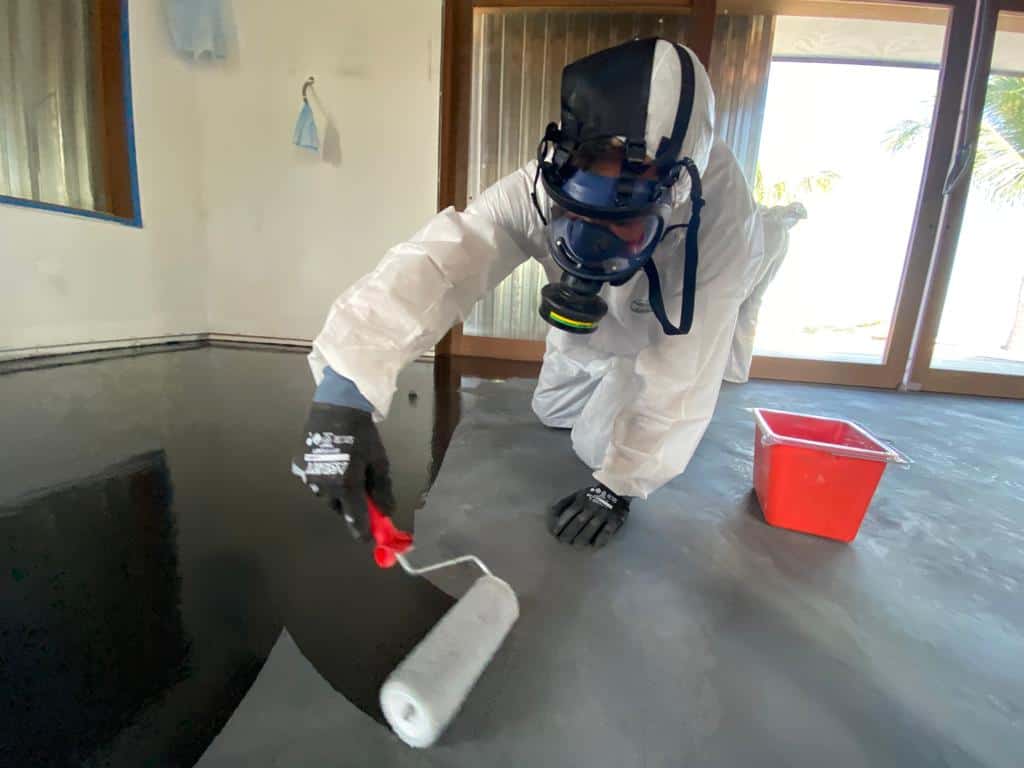
Marius Aurenti protection products
The worksite protocol that ensures durability
The performance of a concrete varnish depends as much on the product as on the protocol. A high-end varnish applied incorrectly will deliver poor results. A substrate that is too damp, an approximate mix, an overly thick coat or failure to respect recoating times can compromise chemical resistance, mechanical resistance and the final appearance.
1. Check the substrate
The substrate must be sound, clean, dry, dust-free and free from greasy stains. In renovation work, an old layer of varnish or fixative must be sanded to recreate adhesion.
Before applying a two-component system, the ambient temperature, substrate temperature, substrate moisture and relative air humidity must be checked. The dew point must be respected to prevent condensation.
2. Weigh the components
For two-component products, the proportions between the base and the hardener must be respected. A scale is essential. Measuring “by eye” alters polymerisation and reduces mechanical and chemical performance.
3. Apply the right quantity
Protection comes from the total amount applied, not from the thickness of a single coat. A coat that is too thick can cause bubbling, poor film levelling, appearance defects or fragility. Several thin, even, cross-applied coats should therefore be applied until the specified consumption is reached.
4. Respect the time between coats
Each system has its own recoating times. Applying the next coat too soon can soften the previous layer. Waiting too long may require dulling or light sanding before applying the next coat.
5. Protect the worksite during curing
During application and drying, dust, wind, direct sunlight, frost, excessive humidity and other work that generates particles should be avoided. On a recently varnished floor, full use should not be rushed. Touch-dry does not mean fully cured.
What a concrete varnish should not promise
A concrete varnish is not a structural waterproofing system. In a shower, bathroom or damp room, the waterproofing of the substrate must be treated before applying microcement, using systems suited to the worksite. The varnish seals the surface porosity and makes maintenance easier, but it does not replace an underlying waterproofing system.
A concrete varnish is not insensitive to prolonged and repeated exposure. Standing water, flowerpots placed directly on the surface, forgotten damp sponges, highly acidic or alkaline products, bleach, solvents, nail polish removers, certain hydroalcoholic gels and prolonged contact with aggressive chemical products should be avoided.
A concrete varnish should not be confused with a wax. Wax is a maintenance or appearance layer. On floors, kitchens, bathrooms and surfaces subject to intensive use, the main protection system must be chosen according to the real technical constraints.
Maintenance and renovation
Routine maintenance should be carried out with gentle products suited to varnished surfaces. Aggressive, abrasive, acidic, alkaline or highly solvent-based products should be avoided.
In the event of micro-scratches or loss of sheen, a maintenance wax can prolong the surface appearance if the varnish is sound. When the varnish is worn, stained, whitened, deeply scratched or locally damaged, a technical renovation should be considered: cleaning, degreasing, light sanding, dust removal, then application of new protective coats according to the technical data sheet.
A well-maintained surface should be renovated before it becomes degraded. Waiting until the concrete absorbs water or stains penetrate means intervening too late.